Naktuinbouw contributes to a sustainable food supply and a healthy living environment. As an independent authority, we ensure market access to suitable, healthy, and reliable propagating material.
Through our inspections, certifications, and studies, we monitor the production and trade of propagating material, so entrepreneurs can confidently trade their products nationally and internationally. We are accountable for this to the Minister of Agriculture, Fisheries, Food Security and Nature.
By building and sharing knowledge with companies, governments, and organizations – both nationally and internationally – we strengthen the sector and stimulate innovation. We apply high standards in everything we do and are accountable to the government, entrepreneurs, and society. In this way, we increase the impact of the horticultural sector together.
Naktuinbouw, serving quality.
The quality service for plant material in the horticultural sector
Every company in the Netherlands that trades in propagating material is legally required to register with an inspection body. We are there for plant material in the horticultural sector.
Naktuinbouw works at the beginning of the supply chain. We provide transparent, expert assessment and certification of plant propagating material and plant varieties. We inspect seeds and planting material for flowers, vegetables, and trees. The Ministry of Agriculture, Fisheries, Food Security and Nature (Dutch: Ministerie van Landbouw, Visserij, Voedselzekerheid en Natuur; LVVN) and the Netherlands Food and Consumer Product Safety Authority (Dutch: Nederlandse Voedsel- en Warenautoriteit; NVWA) oversee our work.
As an independent administrative body, we operate independently.
Working in accordance with European directives and regulations
The Dutch Seeds and Plant Material Act and the EU Plant Health Regulation form the basis for our inspections. With a quality document and plant passport, companies are permitted to trade cuttings, seeds, young plants, and trees within the European Union (EU). Naktuinbouw verifies that companies and their propagating material meet all requirements. We also monitor the correct use of the plant passports that are mandatory in Europe.
The Naktuinbouw Inspection Regulations outline how we structure our inspections. We incorporate the supplier's quality system and the measures taken by the producer.
Testing propagating material for diseases and pests
Testing provides insight into the quality of propagating material. The Naktuinbouw laboratories examine propagating material for the presence of harmful viruses, fungi, bacteria, nematodes, and other organisms. Using advanced techniques and specialized knowledge, we test propagating material according to the latest scientific and technological developments and contribute to reliable resistances. Using DNA techniques, we are increasingly able to determine the identity and origin of plant varieties and pathogens. We do this for companies, our variety research (management of reference collections), and for our inspections.
Identity testing is performed based on validated protocols. Where possible, we use DNA markers and other techniques. We also develop new tests for our laboratories and our sector. We also validate testing methods. If necessary, we make a diagnosis based on the characteristics and symptoms of diseased plant material. We do this for propagating material and end products in vegetable, nursery, and floricultural crops. In this process, we work closely with specialists from the Netherlands and abroad.
Companies can bring fruit crops into the EU through a quarantine procedure with Naktuinbouw. We also develop disease-free propagating material for fruit and ornamental crops.
Promoting effective Plant Variety Protection systems across the world
Plant Breeders’ Rights is an indispensable tool for breeders in the (continued) development of new plant varieties. Developing a new variety requires time, money, and effort. Plant Breeders’ Rights protect intellectual property, allowing breeders to profit from their innovation.
Everyone may use varieties protected by Plant Breeders’ Rights for crossbreeding and further development. New varieties with disease resistance reduce the need for crop protection products and contribute to global food security and sustainable agriculture.
In the Netherlands, the Board for Plant Varieties decides on Plant Breeders’ Rights and the acceptance of varieties. Within the EU, the CPVO performs this task. Naktuinbouw conducts the DUS assessment for both organizations. DUS stands for Distinctness, Uniformity, and Stability.
Recognizable top quality through certification systems
Companies that produce top-quality propagating material can demonstrate this added value by participating in our certification systems. We developed these systems at the request of and in collaboration with the industry. Companies can use them to demonstrate that their material meets higher standards. The shift from Naktuinbouw inspections to internal quality assurance within companies, supported by audits, continues. This increases the independence and responsibility of companies, while guaranteeing reliability and transparency.
Supporting developments in our sector
In July 2023, the European Commission proposed two new regulations specifically addressing the marketing of all plant reproductive material except ornamental plants. The PRM Regulation (Plant Reproductive Material: fruit and vegetable plants) and the FRM Regulation (Forest Reproductive Material: forestry plant reproductive material) will replace the existing directives. These changes impact our work and the sector. We were also closely involved in the discussions in Brussels in 2025.
Actively sharing knowledge with our sector
We do this through excursions, internships, and primary school projects. We also organize meetings, presentations, training courses, and (scientific) research for employees of companies and institutions. We collaborate globally in the areas of diseases, pests, quality, and variety testing. We do this with governments and international organizations, among others.
Governance of Naktuinbouw
Naktuinbouw is an independent administrative body under private law. Its legal structure is the foundation. The foundation's board consists of six members from the sectors and an independent chairperson. The sector councils for Floriculture, Nursery Stock, and Vegetable Crops advise our board.
The two-person board of directors is responsible for day-to-day management and is supported by five domain and department heads. Jacq de Koning, domain head of Health, Testing & Analysis, left Naktuinbouw on August 1st. Director Jan Meiling succeeded him as interim domain head until the end of 2025. In November, the board announced that Bendert de Graaf will be the new domain head, effective January 1st, 2026.
Advisory committees serve as a sounding board for management and advise the sector councils and the board. The members of the board, sector councils, and advisory committees are listed on our website.
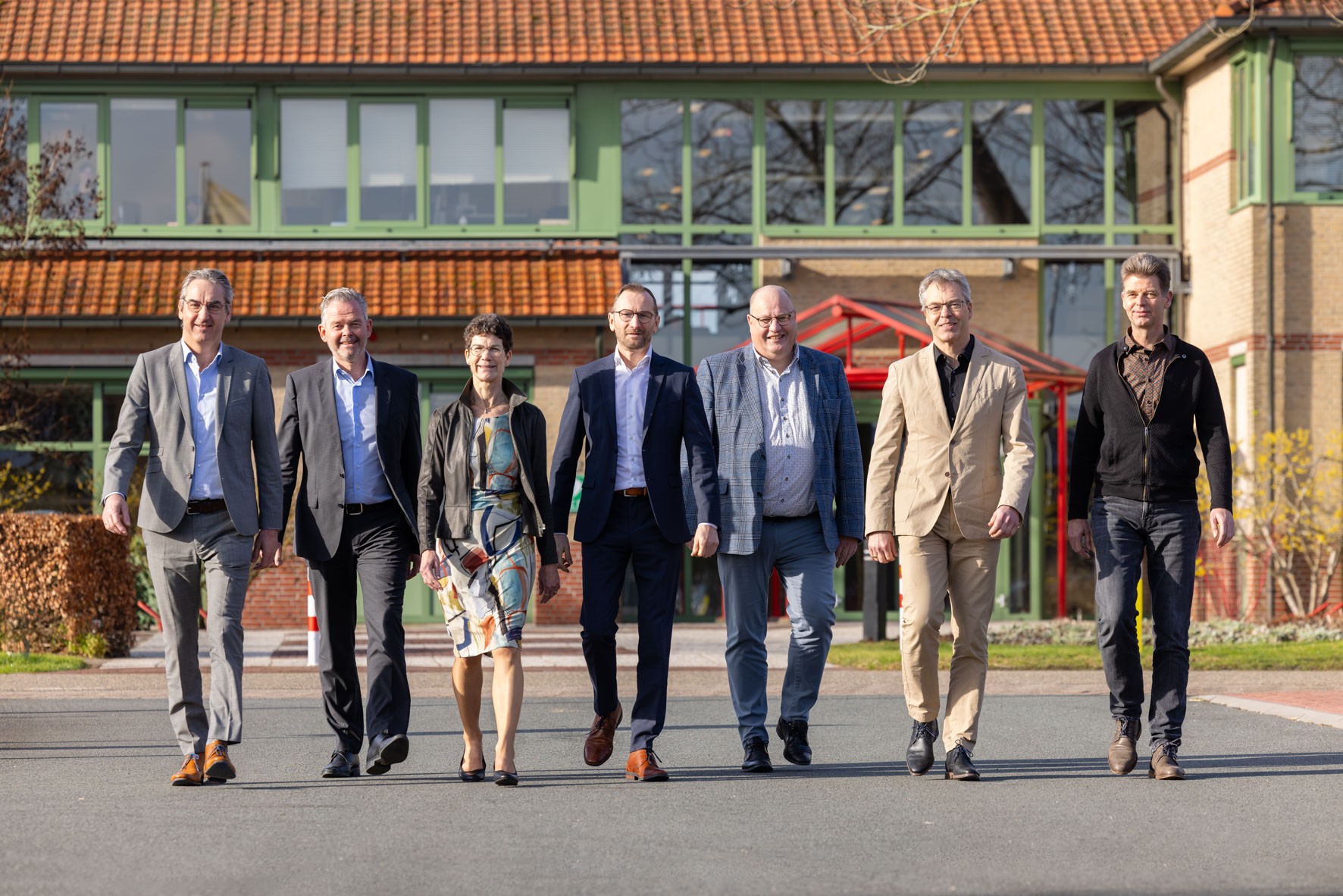
Board and management team in 2025. From left to right:
- Peter van Nieuwkoop (Head of Quality Systems & Inspections)
- Stef Schuijt (Director)
- Hennie Stavleu (Head of Finance, Control & Facility Services)
- Jan Meiling (Director)
- Jacq de Koning (Head of Health, Testing & Analyses) - until August 1, 2025
- Ronald van Wuijtswinkel (Head of Digitalisation & Informatisation)
- Raoul Haegens (Head of Identity & Variety Testing).
New mission, vision, and core values
Our organization, clients, and the world around us are constantly evolving. Therefore, in 2025, we refined our mission, vision, and core values. Throughout the year, we organized internal sessions with employees and management to jointly explore, deepen, and implement the renewed direction in practice. During these meetings, we gathered input, discussed the ‘why’, and collaborated on ways to embed the mission, vision, and core values in our daily work and communications.
In March, the board formally adopted the updated mission, vision, and core values, creating a broadly supported foundation for our course in the coming years.
- Mission: We contribute to a sustainable food supply and living environment by working to ensure global access to suitable, healthy, and reliable growing material.
- Vision: We are a valued and independent authority. We serve the public interest and recognize the needs of the business community. By building and sharing knowledge together, we improve the quality of our services and, consequently, the impact of the sector.
- Core values: reliability, connection, and quality.
Collaboration between inspection services
The six inspection services (BKD, COKZ, KCB, NAK, Skal, and Naktuinbouw) collaborated even more closely in 2025. Knowledge sharing has been increased and across multiple areas, enabling us to learn from each other and work more efficiently. We have become more aware of our position as independent organizations acting in the public interest. We will now collaborate or coordinate our relationships with the government and society.
The inspection services have agreed on the characteristics they can be assessed on to determine when they are performing their work effectively. Such an assessment takes place every five years, as is required by law. Thanks to these agreements, all inspection services are now assessed in the same way.
We have also been supporting each other with staffing for some time now. During busy periods or in vulnerable positions, staff are deployed to a different inspection service. To standardize this, a single fee structure has been created. Costs are now settled uniformly between the inspection services.
Finally, we worked together to improve the security of computer systems. This is necessary to comply with new legal requirements (NIS2). A key component of this is employee training in digital security. Organizing this together has saved significant money.
Digitalization and informatization
We introduced a new collaborative model, bringing various disciplines from across Naktuinbouw together in a single space. We worked together to organize the data, without wasting time waiting for each other. After six months, we concluded that this approach was successful, but that more was needed to get our data in order. We have a complex application landscape with many dependencies and limitations. We realized that in the coming years, we will be working on a digital transformation to achieve more efficient business processes with consistent data usage, a simpler application landscape, and the use of state-of-the-art technology. To this end, we established a Naktuinbouw architectural vision that guides the digital transformation, ensuring we do the right things, and do them right.
Naktuinbouw and sustainability
We are taking important steps to structurally embed sustainability within our organization. In line with the growing responsibility within the sector and our social responsibility, we developed a comprehensive sustainability plan for 2026–2029. This plan forms the basis for targeted actions and measurable results over the next four years.
With this plan, we provide direction for a broad sustainability challenge that affects both our internal operations and our role in the supply chain. We strive for a future-proof organization that responsibly manages energy, materials, and social impact. In 2025, we laid the foundation for this, with a clear focus on six strategic sustainability ambitions. These ambitions are:
- Energy – 10% reduction in consumption and CO2 emissions within two years.
- Mobility – 25% reduction in fossil-fuel kilometres within three years.
- Waste & Circularity – 20% reduction in residual waste within two years.
- Water Use – 15% reduction in consumption within three years.
- Healthy Lifestyle – Stimulate vitality through our company restaurant.
- Awareness & Behaviour – Make sustainable choices together, from purchasing to office use.